Rotating Sit-to-Stand vs. Standard Hospital Beds
A rotating sit-to-stand bed powers the sleeping surface from lying to a seated or near-standing position and turns it toward the side of the bed, completing a bed-to-chair-to-stand transfer at the push of a button. A standard hospital bed only raises the head and foot sections; the person still transfers manually.
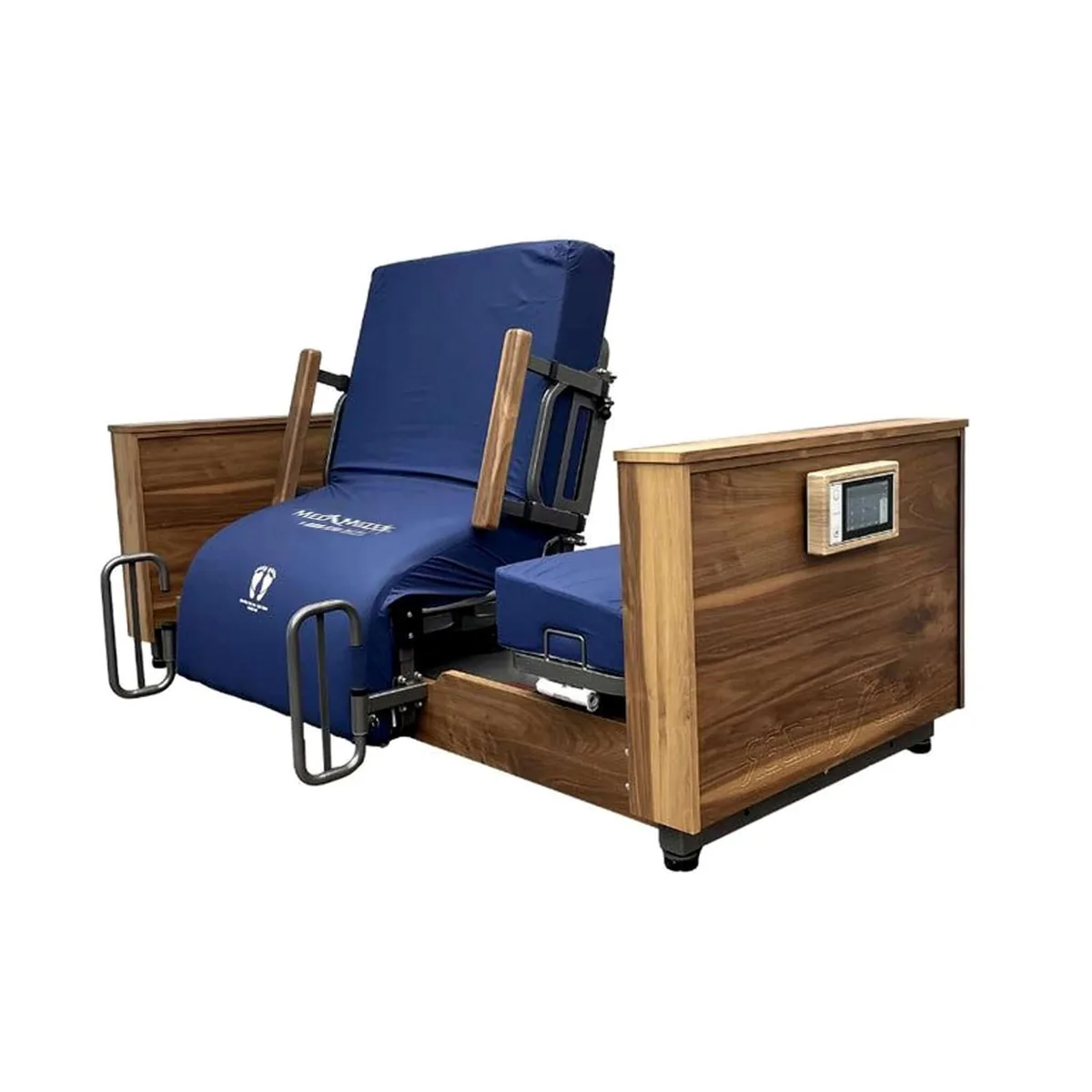
What is the core difference between the two bed types?
A standard (basic) hospital bed articulates: it raises the head section and the foot/knee section, and many models adjust overall height. The mattress stays flat-on relative to the frame, and getting out of bed is still a manual transfer the user or a caregiver performs.
A rotating sit-to-stand bed adds powered motion that a standard bed does not have. The sleeping surface rotates toward the side of the bed and lifts, moving the user from lying down to a seated or near-standing position. Instead of pulling, pivoting, or lifting the person, the bed itself carries them through the transfer. That mechanical bed-to-chair-to-stand sequence is the defining feature, and it is what the four beds we sell are built around.
How does a standard hospital bed work?
A standard hospital bed is built for positioning. Powered actuators lift the backrest so the user can sit up to read, eat, or breathe more comfortably, and raise the knee/foot section to take pressure off the legs. Height adjustment lets a caregiver work at a safe level or lets the user transfer to a wheelchair more easily.
What a standard bed does not do is move the user out of bed. The transition from lying to sitting at the edge, and from the edge to standing, is still done by the person or with caregiver assistance. For users with good upper-body strength and balance, that is often perfectly adequate, and a standard bed is simpler and less expensive.
How does a rotating sit-to-stand bed work?
A rotating sit-to-stand bed combines articulation with a powered rotation-and-lift system. The platform turns the mattress toward one side of the bed and elevates it, so the user ends up seated on the edge or raised toward a standing posture, facing outward and ready to move. Direction is selectable to suit the room and the user.
The models we carry illustrate the range. The Arlo offers 90° rotation left or right with head elevation around 90°. The UPbed Independence functions as bed, rotating chair-bed, and lift assist with two silent independent motors. The Med-Mizer ActiveCare and ActiveCare Deluxe use patented SafeTurn powered bed-to-chair rotation, right- or left-hand.
What do you gain with a rotating sit-to-stand bed?
The main gain is the powered transfer itself. Rather than relying on the user's strength or a caregiver's lifting, the bed mechanically repositions the person from lying to seated or near-standing. That can make a daily routine more independent for the user and physically easier for a caregiver.
You also gain configurability. Capacities in our range run from 450 lb on the Arlo up to 600 lb on the Med-Mizer models, with adjustable height ranges (for example 19.5"–34.5" on ActiveCare) so the seated exit height matches the user. Higher-end models add features such as RollBack on the Deluxe, which reduces shearing as the head rises, and optional Trendelenburg positioning.
What do you give up compared with a standard bed?
Cost is the clearest trade-off. A rotating sit-to-stand bed is a more complex piece of equipment than a basic articulating bed, and prices reflect that — our range runs from $3,877 to $12,787. A standard hospital bed is typically the lower-cost option.
You also take on more mechanism. Rotating beds use additional motors and a moving platform, and they need adequate clear floor space on the rotation side so the surface can turn and the user can exit. If a person can already transfer safely on their own, the powered rotation may be more capability than the situation requires. Matching the bed to the actual transfer need is the key decision.
When does each type make sense?
A standard hospital bed is a sensible fit when the user mainly needs positioning — sitting up, elevating the legs, adjusting height — and can still transfer in and out with their own strength or routine caregiver help.
A rotating sit-to-stand bed makes sense when the transfer itself is the hard part: when lying-to-standing is unsafe, exhausting, or requires heavy lifting from a caregiver. Conditions like Parkinson's, MS, post-stroke recovery, post-surgical recovery, or general limited mobility are often where buyers look at powered transfer. This is general buying guidance, not medical advice — consult a clinician about what suits a specific person.
How should I choose between them?
Start with the transfer question: can the user get from lying to standing safely today, and will that hold over time? If yes, a standard bed may be enough. If the transfer is the obstacle, a rotating sit-to-stand bed is designed for exactly that, and the right model depends on weight capacity, height range, rotation direction, and features.
For a structured walk-through of capacity, dimensions, room fit, and model differences, see our guide on how to choose a rotating sit-to-stand bed, browse the four beds we carry, or call 888-912-2746 for free lifetime in-home tech support and a Lowest Price Guarantee — we'll beat any verified quote from an authorized U.S. seller. Financing is available and delivery includes professional in-home installation nationwide.
Last updated: June 2026
Not sure which bed is right?
Our home medical bed specialists help families choose the safest, best-value bed every day. Free consultation, no pressure.